
European Metrology

Metrology, the science of measurement, is one of the oldest sciences going back as far as recorded history. From rudimentary measurements that supported early, geographically isolated communities, to technological developments and scientific advancements in today’s world; measurements underpin everything around us. Our transportation systems, the heating in our homes or offices, and the food we consume, all depend on metrological infrastructures that pervade all levels of human activity. Even worldwide trade is only possible because of the principle of a common, standardised system of measurements. Through the work of metrological organisations, like EURAMET and WELMEC, we now rely on an International System of Units (SI) – for which the basis was laid with the Meter Convention in 1875 - to enforce globally consistent measurements for international trade and scientific accuracy. Today, the SI continues to evolve, with its base units last undergoing a major redefinition in 2019 to ensure the system’s suitability for our 21st century world.

86
WELMEC & EURAMET Guides
30
WELMEC Working Groups, EURAMET Technical Committees & European Metrology Networks
116
WELMEC & EURAMET Member Organisations

Early measurements

In these very early days of human civilisation, when cultures were restricted to small groups, there was little need for anything more than a locally-agreed measurement system for regional trade or construction. However, as societies began to spread and trade, there became a growing need for measurement standardisation, and many measurements started to be formalised to physical representations such as rods or chains, that had a defined weight or length. One of the most enduring systems of measurement was that of the Romans (c. 800 B.C.–500 A.D.). Almost 500 years later, this measurement system was revived and disseminated throughout the western world by the Holy Roman Emperor Charlemagne. This remained as the basis for European measurements for the next thousand years, but by the time of the French revolution (1789), it had become far too fragmented. At the end of the Renaissance period in the 17th century, the idea of a universal measurement system began to be increasingly disseminated by influential theologians, scientists and politicians.


The Birth of the Metric System
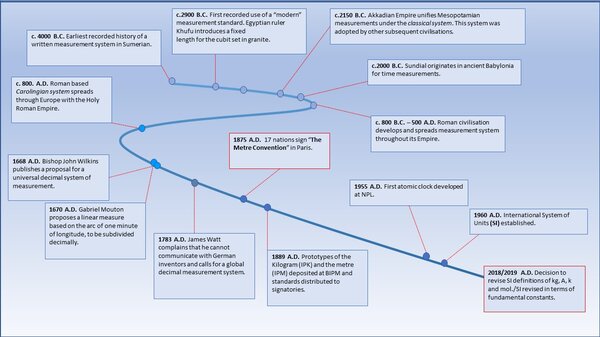


In 1670, a new unit of length was proposed by French abbot, Gabriel Mouton, linked to what was considered a physical constant at the time – the Earth’s circumference. Almost a century later, in 1790, the Academy of Sciences started to work on the best way to standardise length based on Mouton’s ideas. It was decided that the new unit, the ‘metre’, would be determined as 1/10,000,000th of the distance from the North Pole to the Equator.

This became a reality three years later, with the creation and deposition of two metre standards in the Archives de la République in Paris. From this new measurement of length, two further units were derived; the kilogram (defined as the weight of water in a cube whose sides are one-tenth of one metre), and the litre (defined as the volume of one kilogram of water).


This new system slowly gained acceptance, and, on 20 May 1875, 17 nations signed the ‘Metre Convention’ with the aim of promoting the metric system, creating standards for the metre and the kilogram, and setting up an organisation to maintain and coordinate comparisons. Another important step was the incorporation of the ‘astronomical second’ as the unit of time.

At the 11th meeting of Metre Convention signatories in 1960 (otherwise known as the General Conference on Weights and Measures), the International System of Units (Système International d'Unités) - or SI - was introduced. Three further units were ratified for use in the system; the ampere (electrical current), the kelvin (thermodynamic temperature) and the candela (luminous intensity). Eleven years later, the mole was added as well, the unit for the amount of a substance, completing the set of SI base units that are in use today.

Logo-Footer Element 2